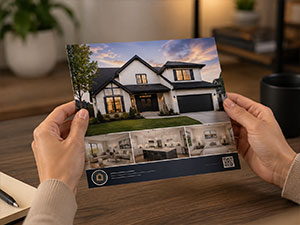
Coordinate signs, cards and leave-behinds around the homeowner decision.
Property professionals and home-service teams need print at different points in a high-trust decision. A sign attracts attention, a card makes the referral easy and a brochure explains the process. Tight Designs helps connect those pieces.
Answer the question that exists at the property.
At a listing, a passerby may only need the address, a viewing action and a contact route. After a conversation, a homeowner may need a process, a service boundary and a reason to trust the next step. A coordinated print kit gives each moment the right amount of information.
A useful print kit
- Property or job-site sign: make the location, direction or current action clear from the approach.
- Business card: identify the person, specialty and preferred follow-up route for referrals.
- Leave-behind brochure: show the steps, options and questions a homeowner is likely to ask later.
- Flyer or door hanger: offer one permission-based reason to start a conversation, with a trackable destination.
Before choosing material, clarify where the piece will be displayed, who is responsible for permission, what weather it may meet and whether the quote includes hardware, delivery or installation. Product, production and fulfillment details are confirmed for each quote.
Local campaign ideas
Example only — not a customer claim: a contractor serving Englewood and Venice could pair a small project-process brochure with a referral card. The brochure explains inspection, estimate, scheduling and follow-up; the card gives a neighbor a simple way to ask a question. The system reduces uncertainty without inventing guarantees or results.
A real-estate team near Venice Avenue might use a listing sign to create the first stop and a neighborhood guide to answer the second set of questions. Any address, client name, property image, testimonial or outcome needs written permission and a current review.
Trust is in the details
Proof every phone number, license or credential reference, URL, QR code, service area, appointment instruction and date. Keep claims specific and supportable. If a detail changes often, place it on a controlled landing page rather than on a large run of printed pieces. The artwork checklist can help catch small but costly errors.
Make the next homeowner question easier to ask.
Good print does not need to answer everything. It needs to make the next useful conversation obvious and give the reader a trustworthy way to begin.